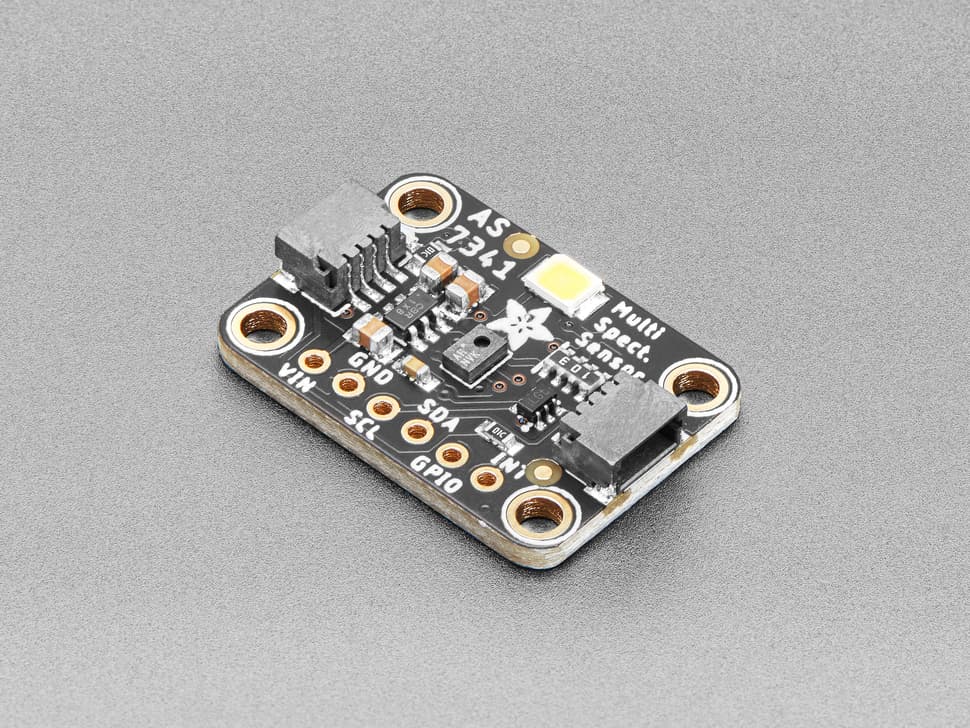
AS7341 10-Channel Light / Color Sensor Breakout - STEMMA QT / Qwiic
sku ADA-4698 · categoríacategory sensors
factura o tiquete electrónicoprice in USD
electronic invoice or receipt
quedan 22 left — envíos desde San José— ships from San José
cantidadquantity
- [✓] Envío desde San José, CR: por Correos de Costa Rica, o retiro en Centro Colón. Costo y plazo en el checkout.Ships from San José, CR: by Correos de Costa Rica, or pickup at Centro Colón. Cost and timing at checkout.
- [✓] Envío gratis con Correos en pedidos desde $200.00 antes de IVA.Free shipping by Correos on orders of $200.00 or more before VAT.
- [✓] Factura electrónica: pídala en el checkout con su cédula o la de su empresa.Electronic invoice: ask for it at checkout with your ID or your company's.
- [✓] PagoPayment: Tarjeta de crédito o débito (Tilopay)Credit or debit card (Tilopay) · Compra-Click (enlace de pago por correo)Compra-Click (payment link by email) · Pagar al retirar en Centro Colón (datáfono)Pay at pickup in Centro Colón (card terminal) · SINPE MóvilSINPE Móvil · Depósito o transferencia bancariaBank deposit or transfer.
- [✓] CuentaAccount: para comprar se inicia sesión.needed to check out. Crear cuentaCreate an account
- [✓] ¿Dudas?Questions? contacto y soportecontact and support
$ cat specs.txt
- sensorsensor
- AS7341AS7341
- canaleschannels
- 10 canales de luz más detección de parpadeo10 light channels plus flicker detection
- bandas de colorcolor bands
- 8 bandas superpuestas8 overlapping bands
- sensores integradosintegrated sensors
- 1616
- detección adicionaladditional detection
- Luz blanca, infrarrojo cercano, parpadeoWhite light, near infrared, flicker
- adcadc
- 16 bits, 6 canales16-bit, 6 channels
- interfazinterface
- I2CI2C
- conectoresconnectors
- STEMMA QT / QwiicSTEMMA QT / Qwiic
- voltaje lógico compatiblecompatible logic voltage
- 3.3V o 5V3.3V or 5V
- huella del chipchip footprint
- 3x2mm3x2mm
- pines adicionalesadditional pins
- GPIO e interrupciónGPIO and interrupt
- compatibilidadcompatibility
- Arduino Uno, Raspberry Pi, tarjetas CircuitPythonArduino Uno, Raspberry Pi, CircuitPython boards
- cable qtqt cable
- No incluidoNot included
a agregar al carritoadd to cart← → fotosphotosg c ir al carritogo to cart
El Adafruit AS7341 10-Channel Light / Color Sensor Breakout es un espectrómetro multicanal, un tipo especial de sensor de luz capaz de detectar no solo la cantidad de luz presente, sino también la cantidad de luz dentro de diferentes longitudes de onda. Esto significa que puede usarlo para detectar, mucho mejor de lo que es capaz el ojo humano, qué color o colores de luz están presentes.
El AS7341 integra en su huella de 3x2mm 16 sensores diferentes que pueden detectar 8 bandas separadas y superpuestas de luz de color. Por si fuera poco, también incluye sensores para luz blanca y para luz infrarroja cercana, e incluso sensores diseñados específicamente para detectar el parpadeo (flicker) de la luz a frecuencias específicas, como el de la iluminación de interiores.
Las capacidades sobrehumanas de medición de color del AS7341 pueden usarse para cuantificar la composición específica de cualquier color interesante al que lo apunte, y puede hacerlo con más precisión y especificidad que un artista bien entrenado. Ahora no necesita ir a una escuela de arte para distinguir el Smalt del Ultramarine; en su lugar, el AS7341 puede darle una idea de qué tan azul es su azul. Esto es posible gracias a que la impresionante colección de sensores del AS7341 se enruta a través de un ADC de 16 bits y 6 canales que toma las mediciones en bruto y las convierte en valores digitales que se pueden leer por I2C.
11 elementos sensores individuales legibles (10 canales de luz más la detección de parpadeo) no caben exactamente en un ADC de 6 canales al mismo tiempo, por lo que el chip incluye un llamado Super MUX (SMUX) que le permite enrutar la señal de cualquier sensor a cualquier canal del ADC. ¡Eso sí es súper multiplexación! El sensor también tiene pines GPIO y de interrupción que le permiten comunicarse directamente con otros sensores o con el propio microcontrolador.
Toda esta capacidad se vuelve accesible al montar el sensor en una tarjeta breakout con formato STEMMA QT, con circuito de conversión de nivel y conectores Stemma QT compatibles con SparkFun Qwiic. Esto significa que puede, sin necesidad de soldar, conectar nuestro breakout AS7341 al microcontrolador de 3.3V o 5V de su preferencia, ya sea un Arduino Uno, una Raspberry Pi o una de las muchas tarjetas compatibles con CircuitPython, como nuestra IdeaBoard. Aunque ciertamente requiere algo de trabajo lograr que todos esos sensores de luz compartan sus mediciones, nuestras bibliotecas de Arduino y CircuitPython se encargan de todo ese trabajo pesado por usted e incluso incluyen código de ejemplo para ayudarle a empezar. El cable QT no está incluido, pero tenemos una variedad en la tienda.
Documentos
The Adafruit AS7341 10-Channel Light / Color Sensor Breakout is a multi-channel spectrometer, which is a special type of light sensor that is able to detect not only the amount of light present but also the amounts of light within different wavelengths. This means that you can use it to detect much better than the human eye is capable of, what color or colors of light is present.
The AS7341 packs within its 3x2mm footprint 16 different sensors that can detect 8 separate, overlapping bands of colored light. As if that weren't enough, it also includes sensors for white light as well as Near Infra-red light, and even sensors made specifically for detecting light flicker at specific frequencies from things like indoor lighting.
The super-human color measuring capabilities of the AS7341 can be used to quantify the specific makeup of whatever interesting colors you can point it at, and can do so with more accuracy and specificity than a well-trained artist. Now you don't need to go to art school to tell Smalt from Ultramarine, instead, you can have the AS7341 can give you a clue how blue your blue is. This is possible thanks to the impressive collection of sensors in the AS7341 being routed through a 16-bit 6-channel ADC that takes the raw measurements and converts them to digital values that can be read out over I2C.
11 readable individual sensor elements (10 light channels plus flicker detection) don’t exactly fit through a 6-channel ADC all at once, so the chip includes a so-called Super MUX (SMUX) that allows you to route the signal from any sensor to any ADC channel. Now that’s some super multiplexing! The sensor also has GPIO and interrupt pins that can allow it to communicate directly with other sensors, or the microcontroller itself.
All of this capability is made accessible by mounting the sensor on a STEMMA QT form factor breakout board, complete with level shifting circuitry and SparkFun Qwiic compatible Stemma QT connectors. This means that you can, without needing to solder, connect our AS7341 breakout into your 3.3V or 5V microcontroller of choice be it an Arduino Uno, Raspberry Pi, or one of the many CircuitPython-compatible boards like our IdeaBoard. While it certainly takes a bit of work to make all those different light sensors share their measurements, our Arduino and CircuitPython libraries take care of all of that hard work for you and even include example code to help get you started. QT Cable is not included, but we have a variety in the shop.