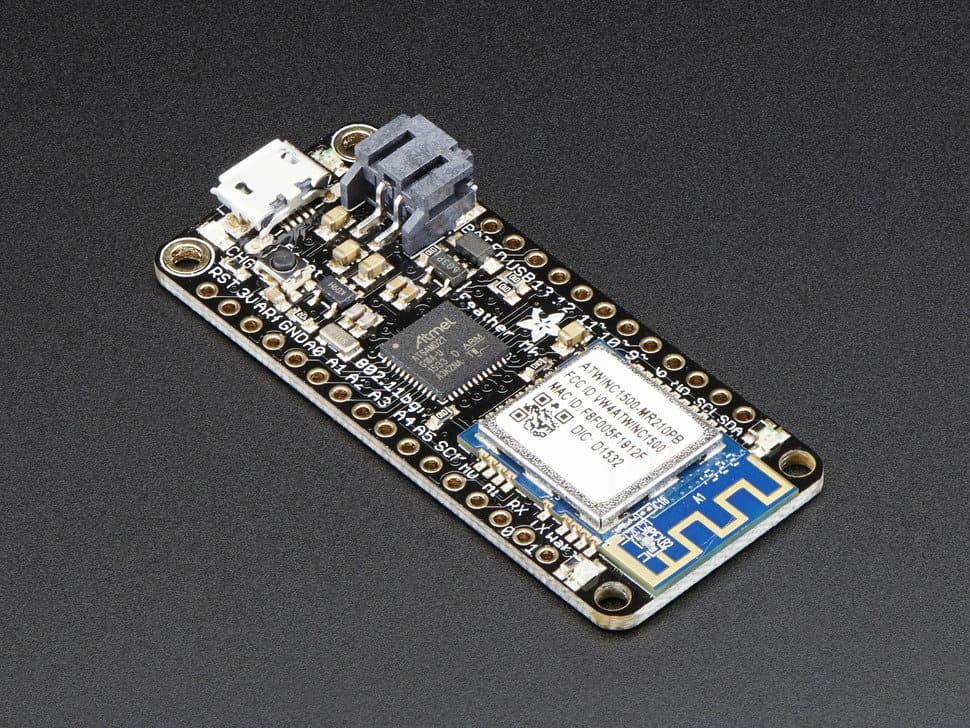
Adafruit Feather M0 WiFi - ATSAMD21 + ATWINC1500
sku ADA-3010 · categoríacategory wireless
factura o tiquete electrónicoprice in USD
electronic invoice or receipt
en stockin stock — envíos desde San José— ships from San José
cantidadquantity
- [✓] Envío desde San José, CR: por Correos de Costa Rica, o retiro en Centro Colón. Costo y plazo en el checkout.Ships from San José, CR: by Correos de Costa Rica, or pickup at Centro Colón. Cost and timing at checkout.
- [✓] Envío gratis con Correos en pedidos desde $200.00 antes de IVA.Free shipping by Correos on orders of $200.00 or more before VAT.
- [✓] Factura electrónica: pídala en el checkout con su cédula o la de su empresa.Electronic invoice: ask for it at checkout with your ID or your company's.
- [✓] PagoPayment: Tarjeta de crédito o débito (Tilopay)Credit or debit card (Tilopay) · Compra-Click (enlace de pago por correo)Compra-Click (payment link by email) · Pagar al retirar en Centro Colón (datáfono)Pay at pickup in Centro Colón (card terminal) · SINPE MóvilSINPE Móvil · Depósito o transferencia bancariaBank deposit or transfer.
- [✓] CuentaAccount: para comprar se inicia sesión.needed to check out. Crear cuentaCreate an account
- [✓] ¿Dudas?Questions? contacto y soportecontact and support
$ cat specs.txt
- microcontroladormicrocontroller
- ATSAMD21G18 ARM Cortex M0 @ 48MHzATSAMD21G18 ARM Cortex M0 @ 48MHz
- módulo wifiwifi module
- ATWINC1500, 802.11b/g/nATWINC1500, 802.11b/g/n
- cifradoencryption
- WEP, WPA, WPA2; SSL TSL 1.2WEP, WPA, WPA2; SSL TSL 1.2
- voltaje lógicologic voltage
- 3.3V3.3V
- memoriamemory
- 256KB FLASH, 32KB SRAM, sin EEPROM256KB FLASH, 32KB SRAM, no EEPROM
- reguladorregulator
- AP2112K-3.3, 600mA picoAP2112K-3.3, 600mA peak
- consumo wifi en transmisiónwifi transmit current
- 300mA pico300mA peak
- pines gpiogpio pins
- 2020
- pines pwmpwm pins
- 88
- entradas analógicasanalog inputs
- 1010
- salida analógicaanalog output
- 1 (DAC 10 bits)1 (10-bit DAC)
- interfacesinterfaces
- Serial, I2C, SPI por hardware; USB nativoHardware Serial, I2C, SPI; native USB
- cargador de bateríabattery charger
- Lipoly 200mA (batería 3.7V)Lipoly 200mA (3.7V battery)
- dimensionesdimensions
- 53.65mm x 23mm x 8mm53.65mm x 23mm x 8mm
- pesoweight
- 6.1 gramos6.1 grams
a agregar al carritoadd to cart← → fotosphotosg c ir al carritogo to cart
Feather es la nueva tarjeta de desarrollo de Adafruit y, como su nombre lo indica (pluma), es delgada, liviana y ¡le permite volar! Diseñamos Feather para que sea un nuevo estándar de núcleos de microcontrolador portátiles. Esta es la Adafruit Feather M0 WiFi w/ATWINC1500 : nuestra versión de una tarjeta 'todo en uno' compatible con Arduino + WiFi de alta velocidad y confiable, con USB y carga de batería integrados. Es una Adafruit Feather M0 con un módulo WiFi, ¡lista para usar!
Conecte su Feather a Internet con este excelente módulo WiFi de Atmel con certificación FCC. Este módulo WiFi compatible con 802.11bgn es lo mejor para conectar sus dispositivos en red, con funciones integradas de administración de bajo consumo, Soft-AP, soporte SSL TSL 1.2 y un desempeño sumamente sólido. Ejecutamos nuestra demo MQTT de adafruit.io durante todo un fin de semana seguido sin ningún problema (habría funcionado más tiempo, pero teníamos que ir a trabajar, así que lo desconectamos). Este módulo es muy rápido y fácil de usar en comparación con otros módulos WiFi que hemos utilizado en el pasado.
Este módulo funciona con redes 802.11b, g o n y soporta cifrado WEP, WPA y WPA2. Puede conectarse a sus propias redes WiFi o crear la suya con el modo "Soft AP", en el que se convierte en su propio punto de acceso (tenemos un ejemplo en el que crea un servidor web desde el cual puede controlar los pines del Arduino). Puede operarlo a una velocidad de hasta 12MHz para una transmisión de paquetes rápida y confiable. Además, el escaneo y la conexión a redes son muy rápidos, apenas uno o dos segundos.
Quizás se pregunte por qué usar esta tarjeta cuando puede conseguir una basada en ESP8266 a bajo costo. Bueno, obtiene:
- Un procesador Cortex M0+ muy capaz, con muchísimos más pines de E/S, muchos ADC de 12 bits, un DAC de 10 bits, 6 SERCOM en total que pueden funcionar cada uno como SPI, I2C o UART (3 los usan las interfaces existentes, por lo que le quedan 3), bastantes temporizadores, PWM, DMA, USB nativo y más (consulte la hoja de datos)
- El ATWINC tiene un consumo de energía mucho menor, aproximadamente 12mA para el WINC y 10mA para el ATSAMD21, con administración automática de energía activada para el WiFi y sin administración de energía para el ARM. Con administración manual de energía, puede reducir el consumo del módulo WiFi a ~2mA poniéndolo en reposo.
- Esto se compara con el consumo promedio de ~70mA del ESP, cuyo modo de reposo profundo requiere un reinicio por WDT.
- También encontramos que podíamos transmitir de forma más confiable (menos 'a ráfagas') con el ATWINC, aunque en general el ESP tiene mayor tasa de transferencia.
- Además, no tiene que hacer 'yield' constantemente al núcleo WiFi, ya que es un chip separado. Tiene control total del procesador y de los tiempos
Por supuesto, ambos tienen sus ventajas y desventajas, ¡y nos gustan los dos por igual!
El corazón de la Feather M0 es un procesador ATSAMD21G18 ARM Cortex M0, a 48 MHz y con lógica de 3.3V, el mismo que se usa en el nuevo Arduino Zero. ¡Este chip tiene nada menos que 256K de FLASH (8 veces más que el Atmega328 o el 32u4) y 32K de RAM (16 veces más)! Este chip incluye USB integrado, por lo que cuenta con capacidad de programación y depuración USB a serial sin necesidad de un chip tipo FTDI. Para usuarios avanzados que dominan ASF, los pines SWDIO/SWCLK están disponibles en la parte inferior y, al conectarlos a un depurador CMSIS-DAP, se pueden usar con Atmel Studio para depuración.
Para facilitar su uso en proyectos portátiles, agregamos un conector para cualquiera de nuestras baterías de polímero de litio de 3.7V y carga de batería integrada. No es necesario usar una batería; funciona perfectamente alimentada directamente desde el conector micro USB. Pero si tiene una batería, puede llevarla a donde quiera y luego conectar el USB para recargarla. La Feather cambia automáticamente a alimentación por USB cuando está disponible. También conectamos la batería mediante un divisor a un pin analógico, para que pueda medir y monitorear el voltaje de la batería y detectar cuándo necesita recarga.
¡Estas son algunas especificaciones útiles! Como todas las Feather M0, obtiene:
- Mide 2.1" x 0.9" x 0.3" (53.65mm x 23mm x 8mm) sin headers soldados. Tenga en cuenta que es 0.1" más larga que la mayoría de las Feather
- Liviana como una pluma (¿grande?): 6.1 gramos
- ATSAMD21G18 @ 48MHz con lógica/alimentación de 3.3V
- 256KB FLASH, 32KB SRAM, sin EEPROM
- Regulador de 3.3V (AP2112K-3.3) con salida de corriente pico de 600mA; el WiFi puede consumir 300mA pico durante la transmisión
- Soporte USB nativo, incluye bootloader USB y depuración por puerto serial
- También obtiene muchísimos pines: 20 pines GPIO
- Soporte de Serial por hardware, I2C por hardware y SPI por hardware
- 8 x pines PWM
- 10 x entradas analógicas
- 1 x salida analógica
- Cargador lipoly integrado de 200mA con LED indicador de estado de carga
- LED rojo en el pin #13 para parpadeo de uso general
- Pin de alimentación/habilitación
- 4 agujeros de montaje
- Botón de reinicio
Viene completamente ensamblada y probada, con un bootloader USB que le permite usarla rápidamente con el Arduino IDE. También incluimos headers para que pueda soldarlos y conectarla a una protoboard sin soldadura. Batería lipoly y cable MicroUSB no incluidos (¡pero tenemos muchas opciones en la tienda si las desea!)
Feather is the new development board from Adafruit, and like its namesake it is thin, light, and lets you fly! We designed Feather to be a new standard for portable microcontroller cores. This is the Adafruit Feather M0 WiFi w/ATWINC1500 - our take on an 'all-in-one' Arduino-compatible + high speed, reliable WiFi with built in USB and battery charging. Its an Adafruit Feather M0 with a WiFi module, ready to rock!
Connect your Feather to the Internet with this fine new FCC-certified WiFi module from Atmel. This 802.11bgn-capable WiFi module is the best new thing for networking your devices, with built-in low-power management capabilites, Soft-AP, SSL TSL 1.2 support and rock solid performance. We were running our adafruit.io MQTT demo for a full weekend straight with no hiccups (it would have run longer but we had to go to work, so we unplugged it). This module is very fast & easy to use in comparison to other WiFi modules we've used in the past.
This module works with 802.11b, g, or n networks & supports WEP, WPA and WPA2 encryption. You can connect to your own WiFi networks or create your own with "Soft AP" mode, where it becomes its own access point (we have an example of it creating a webserver that you can then control the Arduino's pins). You can clock it as fast as 12MHz for speedy, reliable packet streaming. And scanning/connecting to networks is very fast, just a second or two.
You might be wondering why use this when you can get an ESP8266 based board for cheap? Well, you get:
- A highly-capable Cortex M0+ processor with ton more I/O pins, lots of 12-bit ADCs, a 10-bit DAC, 6 total SERCOMs that can each do SPI, I2C or UART (3 are used by the existing interfaces, leaving you 3), plenty of timers, PWMs, DMA, native USB, and more (check out the Datasheet)
- The ATWINC has much lower power usage, about 12mA for the WINC & 10mA for the ATSAMD21 with auto-powermanagement on for the WiFi and no power management for the ARM. With manual power management, you can get the WiFi module to down to ~2mA by putting it to sleep.
- This is compared to the ESP's ~70mA average current draw, and whose deep sleep mode requires a WDT reset.
- We also found that we could stream more reliably (less 'bursty') with the ATWINC, although altogether the ESP has higher throughput.
- You also dont have to 'yield' all the time to the WiFi core, since its a separate chip. You get full reign of the processor and timing
Of course, both have their strengths and tradeoffs, & we love both equally!
At the Feather M0's heart is an ATSAMD21G18 ARM Cortex M0 processor, clocked at 48 MHz and at 3.3V logic, the same one used in the new Arduino Zero. This chip has a whopping 256K of FLASH (8x more than the Atmega328 or 32u4) and 32K of RAM (16x as much)! This chip comes with built in USB so it has USB-to-Serial program & debug capability built in with no need for an FTDI-like chip. For advanced users who are comfortable with ASF, the SWDIO/SWCLK pins are available on the bottom, and when connected to a CMSIS-DAP debugger can be used to use Atmel Studio for debugging.
To make it easy to use for portable projects, we added a connector for any of our 3.7V Lithium polymer batteries and built in battery charging. You don't need to use a battery, it will run just fine straight from the micro USB connector. But, if you do have a battery, you can take it on the go, then plug in the USB to recharge. The Feather will automatically switch over to USB power when its available. We also tied the battery through a divider to an analog pin, so you can measure and monitor the battery voltage to detect when you need a recharge.
Here's some handy specs! Like all Feather M0's you get:
- Measures 2.1" x 0.9" x 0.3" (53.65mm x 23mm x 8mm) without headers soldered in. Note it is 0.1" longer than most Feathers
- Light as a (large?) feather - 6.1 grams
- ATSAMD21G18 @ 48MHz with 3.3V logic/power
- 256KB FLASH, 32KB SRAM, No EEPROM
- 3.3V regulator (AP2112K-3.3) with 600mA peak current output, WiFi can draw 300mA peak during xmit
- USB native support, comes with USB bootloader and serial port debugging
- You also get tons of pins - 20 GPIO pins
- Hardware Serial, hardware I2C, hardware SPI support
- 8 x PWM pins
- 10 x analog inputs
- 1 x analog output
- Built in 200mA lipoly charger with charging status indicator LED
- Pin #13 red LED for general purpose blinking
- Power/enable pin
- 4 mounting holes
- Reset button
Comes fully assembled and tested, with a USB bootloader that lets you quickly use it with the Arduino IDE. We also toss in some header so you can solder it in and plug into a solderless breadboard. Lipoly battery and MicroUSB cable not included (but we do have lots of options in the shop if you'd like!)